
As we step into 2026, the cybersecurity landscape is undergoing a seismic shift. It is no longer just about firewalls and antivirus software — it is about defending intelligence itself. The threats are more sophisticated, the stakes are higher, and the tools we once relied on are being outpaced by the very technologies they were meant to defend against. From AI-driven attacks to geopolitical manipulation, these threats are evolving faster than most organizations can adapt.
In this blogpost, we will explore the top cybersecurity predictions for 2026 and what businesses must do to stay resilient.
The Rise of AI-Powered Threats
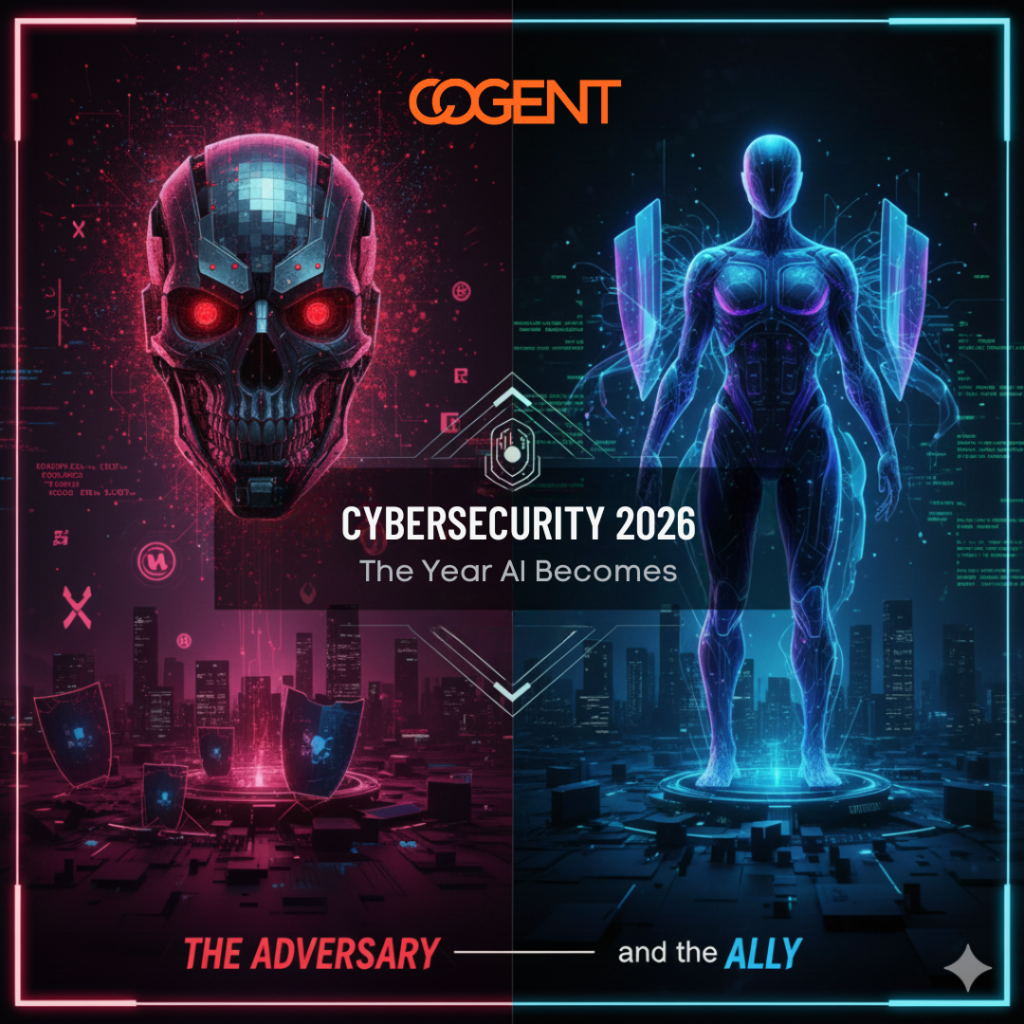
Artificial Intelligence serves as both the attacker and the defender in 2026. Threat actors are leveraging AI to automate phishing campaigns, generate deepfakes, and clone voices with alarming precision. By 2026, we are witnessing the emergence of autonomous adversarial AI—systems capable of discovering vulnerabilities, planning attacks, and executing them without human intervention.
Research indicates that autonomous AI agents can achieve complete data exfiltration up to 100 times faster than human attackers. These aren’t scripted malware programs; they’re self-directed systems that analyze network defenses in real-time, modify their payloads during active attacks, and learn from detection responses to evolve their tactics instantly.
One of the most insidious emerging threats is data poisoning attacks targeting the training datasets of AI models. Unlike traditional data exfiltration, data poisoning involves invisibly corrupting the data used to train AI systems, creating hidden backdoors and fundamentally untrustworthy models. This represents a paradigm shift because the attack is embedded within the very data used to create an organization’s core intelligence.
Organizations also face risks from AI-generated data exhaust—the trail of prompts, outputs, cached data, and embeddings left behind by AI experiments. Security experts predict that 2026 will see major breaches attributed to forgotten vector databases or abandoned AI model repositories containing sensitive information.
This means traditional security measures like firewalls and antivirus software will be insufficient. Organizations need AI-enhanced defense systems that can detect anomalies, adapt to new threats, and respond in real time with behavioral baselining, data integrity verification, and comprehensive observability tools.
Identity Becomes the New Perimeter
The concept of a network perimeter is officially obsolete. Cybersecurity in 2026 revolves around identity rather than infrastructure. By 2026, machine identities outnumber human employees by a staggering 82 to 1 ratio in many enterprise environments. Every API key, service account, and OAuth token represents a potential entry point.
Attackers are increasingly targeting onboarding workflows, help desks, and identity recovery processes. Generative AI has reached a state where deepfakes are virtually indistinguishable from reality. Voice cloning technology, which saw a 1,600% increase in deployment during early 2025, now enables attackers to bypass voice-based authentication systems. The “CEO doppelgänger” threat has become reality—AI-generated replicas of executives capable of commanding enterprise resources in real-time.
Prompt injection attacks represent another critical threat, manipulating AI systems to bypass security protocols and execute hidden attacker commands. Google’s cybersecurity forecasts identify prompt injection as a growing threat, with organizations facing substantial increases in targeted attacks on AI systems.
Zero Trust architecture has become the norm, with continuous authentication and behavioral analytics replacing static credentials. Key implementation elements include passwordless authentication, biometric verification, decentralized identity models, least-privilege access for both human and machine identities, and micro-segmentation to limit lateral movement within networks.
Regulation Tightens Globally
Governments worldwide are stepping up their cybersecurity mandates. In 2026, compliance is no longer optional. The EU’s CE-Cyber Delegated Act enforces cybersecurity standards for wireless products, requiring manufacturers to demonstrate security throughout the entire product lifecycle—from initial design through end-of-life disposal.
Beyond the EU, similar frameworks are emerging globally. The United States has strengthened requirements for critical infrastructure sectors. Asian markets have implemented comprehensive data protection laws requiring local data storage, regular security audits, and rapid breach reporting. India’s Digital Personal Data Protection Act imposes significant obligations on handling citizen data.
For multinational organizations, navigating this complex landscape requires sophisticated compliance automation tools and detailed audit trails demonstrating continuous compliance across multiple frameworks like GDPR, CCPA, HIPAA, SOC 2, and ISO 27001.
Cyber insurance policies have evolved dramatically. Insurers now demand evidence of proactive threat hunting, documented incident response capabilities, measurable employee training programs, vendor risk management processes, and proven business continuity plans. Organizations without demonstrable proactive risk management find coverage increasingly difficult or prohibitively expensive to secure.
Embedded Systems and IoT: The Next Battleground
With the proliferation of smart devices, embedded systems and IoT have become prime targets for cyberattacks. Advanced wireless technologies like Bluetooth 6 and 5G RedCap enable faster, low-power connectivity for industrial IoT, wearable medical devices, automotive systems, and smart city infrastructure. However, they also introduce new vulnerabilities.
Edge computing reduces latency and improves privacy but distributes security responsibilities. Each edge device becomes a potential target, and compromising a single device can provide attackers with a foothold to pivot to other systems.
The integration of AI capabilities directly into embedded systems brings on-device intelligence but creates unique security challenges: model extraction attacks, adversarial inputs designed to fool AI, firmware vulnerabilities in resource-constrained processors, and the need for secure update mechanisms delivering both security patches and model updates.
Manufacturers and enterprises must adopt secure-by-design principles, integrating cybersecurity into the hardware and software lifecycle from the beginning. This means threat modeling during design, secure boot and firmware verification, hardware security modules for cryptographic operations, over-the-air update capabilities with authentication, and supply chain verification to ensure components haven’t been compromised.
Organizations need tighter collaboration between embedded engineers and cybersecurity teams, plus real-time monitoring tools for edge devices to detect anomalies and enable rapid response to potential compromises.
Cybercrime Gets Personal and Political
Cyberattacks in 2026 are not just about stealing data—they are about manipulating perception, disrupting infrastructure, and influencing geopolitics. Deepfake technology creates synthetic voices and videos indistinguishable from authentic recordings, enabling social engineering attacks where deepfake video calls authorize fraudulent wire transfers, market manipulation through fake corporate announcements, and political interference with fabricated statements from officials.
AI enables a new generation of hyper-personalized extortion scams that reference specific details about victims’ lives—their vehicles, homes, family members, or recent purchases. These attacks leverage data from breaches, social media, and public records assembled by AI into convincing narratives tailored to individual victims.
Nation-state actors increasingly target critical infrastructure: energy grids, water treatment facilities, transportation systems, healthcare, financial networks, and telecommunications. Security experts predict botnets capable of generating attacks exceeding 20 terabits per second, creating not only targeted disruption but significant collateral damage.
The year 2026 presents numerous high-profile global events like FIFA 2026, the Super Bowl, Winter Olympics, and various elections, which create significant opportunities for attacks from nation-state actors, cybercriminals, and hacktivists.
Organizations must prepare for reputational attacks with digital forensics teams, media verification tools to detect deepfakes, crisis communication protocols, social media monitoring, stakeholder communication plans, and regular tabletop exercises simulating reputational attack scenarios.
The Human Element Remains Critical
Despite technological advancements, human error remains the leading cause of breaches. Phishing attacks powered by generative AI feature perfect grammar, contextual awareness, dynamic personalization, multi-channel coordination, and artificial urgency—making them indistinguishable from legitimate communications.
Misconfigured cloud settings and poor password hygiene continue to expose sensitive data. Storage buckets with overly permissive access, databases exposed without authentication, and credentials accidentally committed to public repositories remain persistent vulnerabilities.
Cybersecurity awareness training must evolve beyond PowerPoint presentations to immersive simulations, gamified learning, realistic phishing simulations using actual AI techniques, virtual reality scenarios, and AI-driven personalized coaching. The goal is creating a culture of security where every employee becomes a proactive defender of digital assets.
Organizations should implement just-in-time training, positive reinforcement celebrating good practices, security champions programs, and continuous communication keeping security top-of-mind. Success should be measured by actual behavior change—reductions in successful phishing attempts and increased reporting of suspicious activities.
Conclusion: Building Resilience in the Age of Intelligent Threats
Cybersecurity in 2026 is not just about defense—it is about resilience. Organizations must shift from reactive to proactive strategies, embracing AI-powered defense, identity-first security, and global compliance as pillars of their cyber posture.
The concern that “Will we be attacked?” has become obsolete; preparedness is the new focus: “Are we ready to respond, recover, and adapt?” For better preparedness, we must consider security as a strategic tool. It should protect revenue, offer a competitive edge, ensure regulatory compliance, maintain brand value, and foster innovation rather than being just an expenditure.
If your business is serious about building resilience for an AI-powered future, partner with experts who understand the stakes. CogentIBS offers cutting-edge cybersecurity solutions tailored for the challenges of tomorrow, from securing embedded systems to defending against AI-driven threats, implementing Zero Trust architecture, automating compliance, and building a security culture.
Don’t wait for the breach. Build your resilience today and get your blueprint for 2026—because in the era of intelligent threats, only intelligent defenses will survive.