
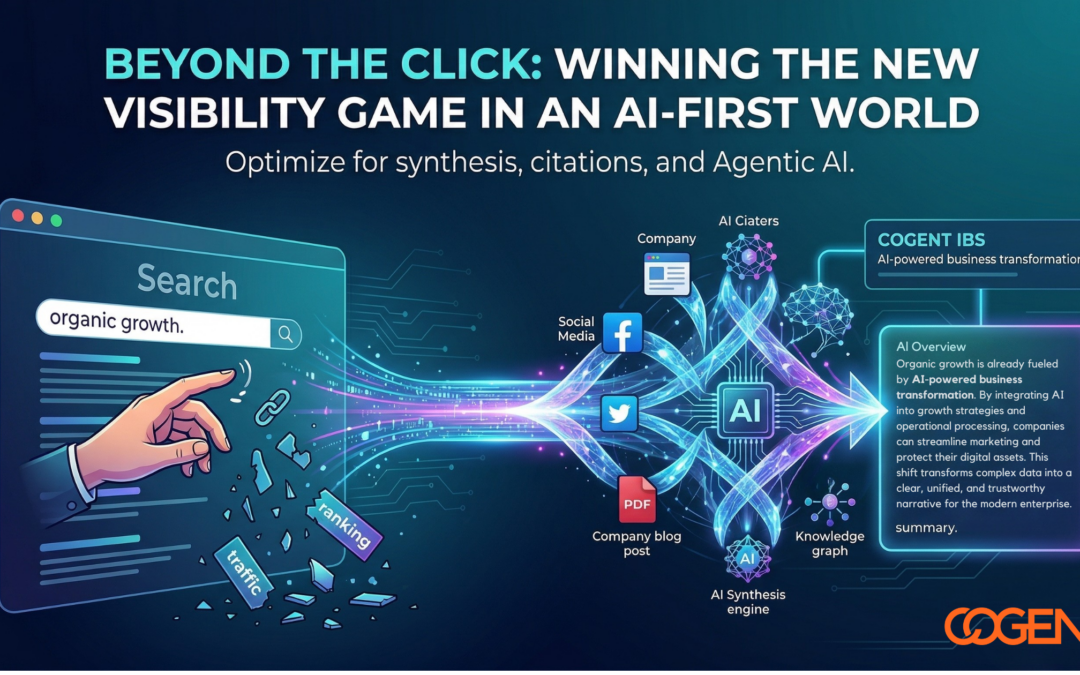
For two decades, digital success was measured in clicks and traffic. Your brand ranked well, users clicked through, and analytics tracked every visit. That playbook is being rewritten before our eyes. Discovery is now happening before the click—inside AI-generated summaries, chat interfaces, and answer engines where traditional metrics cannot reach. If your brand is not visible there, the uncomfortable question becomes: does it even exist?
The paradigm shift is not theoretical. It is quantifiable, urgent, and reshaping competitive dynamics across every industry. Organizations that recognize this transformation and adapt their digital presence for AI-powered business transformation will thrive. Those clinging to rank-and-click strategies will watch their visibility erode, even as their search rankings hold steady.
The Great Unbundling: Why “Rank and Click” Is Dying
LinkedIn’s B2B organic growth team documented a decline of up to 60 per cent in non-branded, awareness-driven traffic across a subset of B2B topics between early 2024 and early 2025, even as rankings remained stable. This was not an isolated incident. Research reveals that 60 per cent of Google searches now end without any click to a website, up from 58 per cent in 2024.
The fundamental driver is simple yet profound: AI does not just list links. It synthesizes answers. Google’s AI Overviews, ChatGPT, Perplexity, and other answer engines provide users with complete responses extracted from multiple sources, assembled into coherent summaries, and delivered without requiring anyone to leave the platform.
This creates what the industry calls “zero-click searches”—queries in which the user’s journey begins and ends within the AI’s response. Research from Seer Interactive found that organic click-through rates plummeted from 1.76 per cent to 0.61 per cent for queries with AI Overviews, a 61 per cent decline. The paid search impact was even more severe, with CTR crashing 68 per cent from 19.7 per cent to 6.34 per cent.
The consequence for digital strategy is stark: traditional SEO metrics like rankings and click-through rates have become lagging indicators of brand visibility. You can rank first and receive a fraction of the traffic you would have captured two years ago. The new battleground is not the position in search results. It is visibility within the AI-generated answer itself—being the source the algorithm chooses to cite, summarize, and attribute.
As search engines evolve into sophisticated answer engines, businesses must shift toward providing context-aware AI for enterprise workflows to ensure their data is parsed accurately by these new gatekeepers.
Google’s Strategic Pivot: Redesigning the Link, Not Removing It
Google understands the existential tension. If AI summaries become destinations rather than waypoints, the open web weakens. And if the web weakens, Google’s own ecosystem collapses. The company is not eliminating links; it is redesigning how they are presented and reinforced.
Recent interface experiments reveal the strategy: hover pop-ups displaying rich site information, including favicons, descriptions, and brand context; more prominent link icons within AI answers; and attribution mechanisms that surface source credibility without requiring clicks to validate authority.
This represents a corrective measure. Google is acknowledging that pure zero-click environments harm the content ecosystem that feeds its AI. But the interface redesign creates a new challenge: brand visibility now depends on clear entity signals that work inside a pop-up preview, not just on a full webpage.
LinkedIn’s Insider Perspective: Adapting to AI-Led Discovery
LinkedIn created an AI Search Taskforce spanning SEO, PR, editorial, product marketing, product, paid media, social, and brand teams to address the visibility challenge. Their strategic response provides a blueprint worth studying.
The first step was landscape immersion. LinkedIn’s team started researching Google’s Search Generative Experience in early 2024, recognizing that when SGE evolved into AI Overviews by early 2025, the impact would become significant. They built networks to understand Generative Engine Optimization and AI-led discovery patterns, tracking how content appeared across ChatGPT, Perplexity, Google AI Overviews, and other platforms.
The second step was cross-functional activation. Rather than treating AI visibility as solely an SEO challenge, LinkedIn aligned teams across the organization to create consistent, reinforcing signals. They corrected misinformation appearing in AI responses, published new owned content optimized for generative visibility, and tested LinkedIn social content to validate its strength in AI discovery.
The New Blueprint for Brands: How to Play and Win
The strategic imperative is clear: adapt your digital presence for AI consumption or accept diminishing visibility. Here is the operational blueprint:
- Audit Your Brand’s AI Presence: Before optimizing, understand your current state. How does your brand appear in citations and previews across ChatGPT, Google AI Overviews, and Perplexity?
- Strengthen Your Structured Signals: For AI systems, structured data is crucial. Schema markup and semantic HTML are no longer enhancements; they are requirements.
- Create Content for Synthesis, Not Just Reading: Write in ways that large language models can easily extract. Use clear headings and explicit answer blocks.
- Align Your Entire Ecosystem: Ensure consistency across your LinkedIn articles, company blog, and social media.
- Adopt New KPIs: Start tracking citation rates, share of voice in AI responses, and entity strength.
The rise of Agentic AI means that software “agents” are now browsing the web on behalf of users; if your site isn’t structured for these agents to navigate, you effectively don’t exist in their results.
The Cogent Perspective: Navigating the Redesigned Doorway
Just as Cogent helps businesses integrate complex systems and architect modern data platforms for AI-powered business transformation, we now help organizations integrate their brands into the AI-driven discovery layer. This requires treating your digital presence as infrastructure designed for both human and AI consumption.
The future is not linkless. It is a more designed, curated, and trust-based link economy. Your competitive advantage will come from clarity of entity representation, authority of expertise signals, and the ability to be the source AI chooses to cite when synthesizing answers in your domain.
Moving Forward: The Visibility Imperative
The transformation from click-driven discovery to AI-mediated synthesis has arrived. Google AI Overviews now appear in 60 per cent of searches in the United States as of November 2025. Publishers globally experienced a 33 per cent decline in Google search traffic over the last year.
The brands that win in this environment will not be those with the highest ad budgets, but those that understand how AI platforms evaluate credibility.
Is Your Organization Ready for the Visibility Game?
At Cogent IBS, we help businesses navigate complex technological transformations. We can help you audit your current AI visibility and build a roadmap for strengthening your presence across AI platforms. From structured data implementation to Agentic AI deployment, we bring a rigorous approach to the AI-first world.
Ready to ensure your brand remains visible as discovery moves into AI platforms?
Contact our team to schedule an AI visibility audit and discuss how we can strengthen your digital presence.