
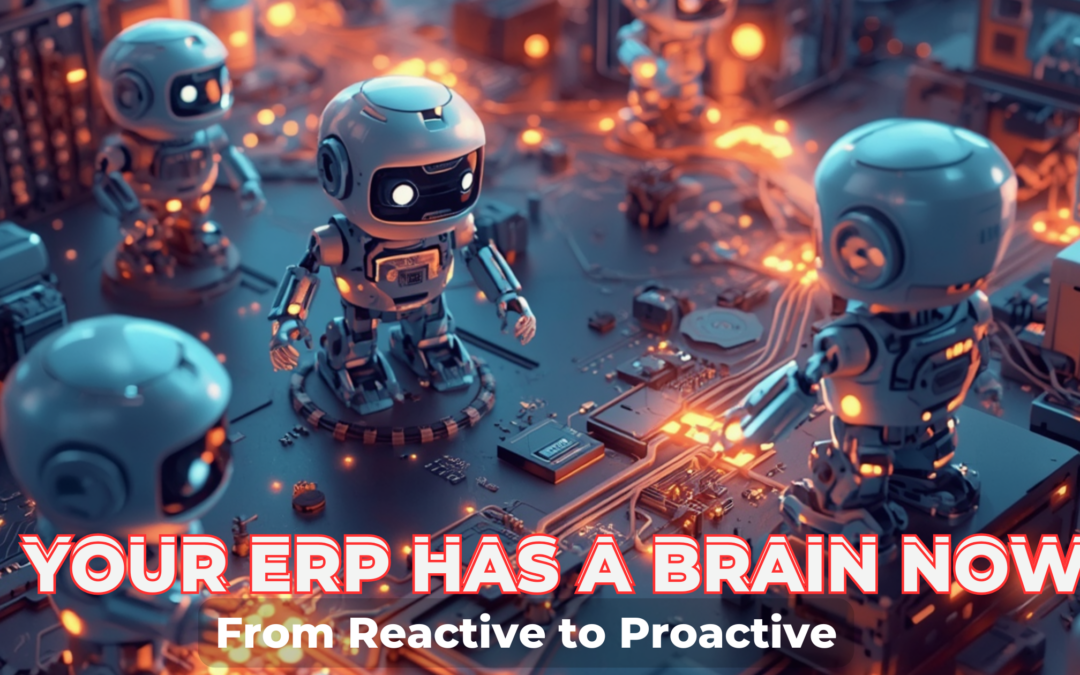
How LLMs and Micro Agents Are Turning Enterprise Workflows From Reactive to Proactive
Let us picture a typical Tuesday morning at a mid-sized manufacturing company.
An invoice arrives from a supplier in Vietnam. The currency is different. The tax code is outdated. The purchase order number is missing. A human accounts payable clerk opens the email, squints at the PDF, cross-references three spreadsheets, calls the supplier, updates the ERP system manually, and marks the task complete. This takes 15 minutes if nothing goes wrong. Multiply that by hundreds of invoices every week.
Now imagine a different Tuesday. The same invoice arrives. An AI agent reads it, extracts the relevant data, checks the purchase order against the ERP system, flags the missing tax code, sends a request to the supplier for correction, and places the invoice in a “pending” folder. The human clerk simply reviews the exception list once a day. No data entry. No phone tag. No spreadsheet gymnastics.
This is not a future fantasy. This is happening right now inside enterprises that have moved beyond chatbots and into the world of agentic AI. Specifically, they are using small, specialized AI agents to breathe intelligence into their ERP workflows. And the results are transforming how work gets done.
From Chatbots to Coworkers: The Evolution of Enterprise AI
When ChatGPT burst onto the scene a few years ago, most businesses reacted the same way. They built a chat window. They connected it to their intranet. They let employees ask questions like “how do I submit an expense report?” and called it digital transformation.
These first-generation tools were helpful but limited. They could answer FAQs, summarize documents, and draft emails. But they could not actually do anything. A human still had to read the answer, open the ERP system, type in the data, and click the buttons. The AI was an assistant, not a worker.
The shift happening today is fundamental. We are moving from conversational assistants to autonomous agents. An assistant responds. An agent acts. It can plan a sequence of steps, call different software tools through APIs, check the results, and adjust its approach without waiting for a human to say “go ahead.”
According to a recent analysis from IT Exchange, the conversation in enterprise technology is rapidly shifting toward autonomous, task-specific micro-AI agents that can operate inside workflows, talk to APIs, and make decisions without a human in the loop for every step. This is not a minor upgrade. It is a new way of designing how work flows through an organization.
What Makes Micro AI Agents Different
The term “micro AI agent” sounds technical. But the idea is simple. Instead of building one giant AI brain that tries to do everything, enterprises are creating many small, focused agents. Each agent handles a single job.
Think of it like a restaurant kitchen. You do not have one chef making every dish from scratch. You have a grill cook, a salad station, a pastry chef, and a dishwasher. Each person has a clear role. They communicate when needed but mostly work in parallel.
Micro AI agents work the same way. Some characteristics make them particularly useful for ERP workflows.
Specialized by design. Each agent is optimized for a narrow task like checking compliance, validating an invoice, or routing a customer ticket. This narrow focus reduces confusion and makes the agent more reliable. A general purpose chatbot might misunderstand a question about tax codes. A dedicated tax code agent never gets confused because that is all it does.
Governable and safe. Because each agent has a limited job, it is easier to set clear boundaries. You can define exactly what data it can access, what actions it can take, and what it is never allowed to do. This makes risk management far simpler than with a single all-powerful AI system.
Reusable across the organization. An agent that validates invoice completeness can work for finance, procurement, and vendor onboarding with almost no changes. Once you build a good agent, you can deploy it anywhere that same task appears.
Built for automation. These agents are designed to plug directly into existing automation systems. They can sit on top of robotic process automation or workflow engines, adding smart decision making where old-school rules and scripts reach their limits.
How AI Agents Transform Real ERP Workflows
Let us move from theory to practice. Here is how micro-AI agents are changing specific enterprise workflows.
- Finance and Procurement: Invoice processing is the classic example. An agent reads incoming invoices, extracts line items, tax numbers, and payment terms from PDFs, then pushes the structured data directly into the ERP system. A separate spend classification agent maps each transaction to the correct cost center and category, feeding analytics dashboards without any human data entry.
For procurement, agents can monitor supplier contracts and automatically flag renewals, price changes, or SLA violations. They do not just surface information. They can initiate the approval workflow or send a notification to the supplier. - Customer Support: When a customer emails a support request, a triage agent reads the message, classifies the intent, detects urgency, and routes it to the right queue. If the issue is simple, like a password reset or a status check, a resolution agent can search the knowledge base, generate a draft response, and even send it automatically. Only the complex or high-risk cases reach a human agent.
- Human Resources: An HR policy agent can answer employee questions about leave balances, travel policies, or benefits by referencing the latest policy documents. A candidate screening agent can summarize hundreds of CVs, match them against job descriptions, and produce a shortlist for recruiters. The recruiter spends time interviewing great candidates, not reading resumes.
- IT and Product Development: For software teams, an agent can cluster customer feedback and support tickets into common themes, then generate candidate backlog items for product managers. Another agent can triage server logs, summarize incidents, and suggest remediation steps for DevOps teams. The human engineers focus on fixing problems, not finding them.
What Cannot Be Automated Yet
Honesty is important here. Not every workflow is ready for fully autonomous agents. Some tasks still need a human in charge.
Strategic decisions with no clear right answer, like whether to enter a new market or acquire a competitor, remain human work. Edge cases in regulated industries like healthcare or finance require human judgment, especially when liability and ethics are on the line. Complex relationship management, such as high-stakes negotiations or sensitive HR cases, depends on context and empathy that AI cannot replicate.
The most effective deployments combine autonomous execution for routine, low-risk tasks with human oversight for exceptions. A finance team might let an agent process 80 per cent of invoices automatically while a human reviews the remaining 20 per cent that fall outside normal patterns. This balance gives you the efficiency of automation without the risk of blind trust.
Process Design Still Matters
Here is a warning that every CIO should read twice. Micro AI agents do not magically fix broken processes. In fact, they make process weaknesses painfully visible.
If your underlying workflow is a mess, an AI agent will execute that mess faster and more consistently. It will not clean it up for you.
For intelligent automation to work at scale, your workflows need three things.
Clear boundaries. Each agent needs a crisp contract. What data does it receive? What output does it produce? What tools can it call? What is it never allowed to do?
Consistent data models. If your CRM system calls a customer “client” and your ERP system calls them “account,” an agent will propagate that inconsistency rather than resolving it. You need common schemas across systems.
Embedded controls. Validation steps, exception routes, and audit trails must be designed from the start. Autonomous actions must remain observable and reversible.
Organizations that succeed with agentic AI are those that already invested in API design, observability, and DevOps practices. The value comes from disciplined process design, not from the AI model itself.
The Bottom Line for Business Leaders
The shift from chatbots to micro AI agents mirrors the shift from monolithic software to microservices. It is not about replacing people. It is about giving every knowledge worker a team of digital helpers that handle the repetitive, rule-based, high-volume tasks that currently eat up their day.
For ERP workflows specifically, this means faster invoice processing, fewer data entry errors, real-time compliance checking, and procurement cycles measured in hours instead of weeks. It means your finance team stops chasing paper and starts analyzing trends. Your HR team stops answering the same policy questions for the hundredth time and starts focusing on employee development. Your IT team stops triaging routine tickets and starts building systems that actually work.
AI agents for enterprises are no longer experimental. They are practical, deployable, and delivering measurable returns for companies that take a disciplined approach to process design. AI-powered decision-making platforms for enterprises are evolving from a buzzword into a competitive necessity.
Is your ERP system ready for agentic AI? Do you know which workflows to automate first and which ones to keep human-led?
At CogentIBS, we help enterprises design, build, and deploy micro-AI agents that work inside your existing systems. We do not sell generic chatbots. We build digital coworkers that handle real work.Visit CogentIBS today to start your agentic AI journey. Let us turn your ERP from a system of