
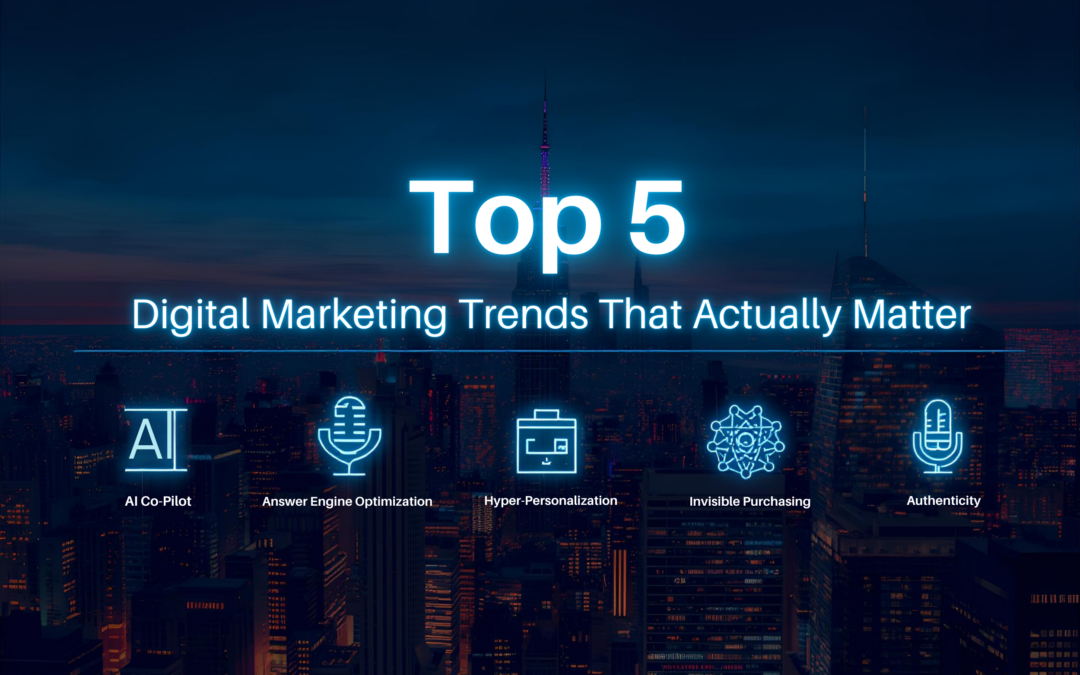
Remember the last time a marketing trend truly stopped you in your tracks? Not just another app update or algorithm tweak, but a fundamental shift in how brands connect with people? As we look toward 2026, we are moving beyond the hype cycle into an era of purposeful integration. The flashy, disruptive technologies are giving way to sophisticated, seamless systems that work for the customer, not just the marketer.
Forget chasing viral moments for the sake of it. The future belongs to strategies that blend artificial intelligence with authentic human insight, prioritize privacy without sacrificing personalization, and create value so intrinsic that marketing feels less like an interruption and more like a service. This blog cuts through the noise to explore the five digital marketing trends poised to redefine success in 2026. These aren’t just predictions; they are the emerging realities that forward-thinking brands are already preparing for.
1. The Rise of the AI Co-Pilot: From Content Creation to Strategic Orchestration
In 2026, AI won’t be a magic content button. It will evolve into a strategic marketing co-pilot. The trend moves from using generative AI for drafting generic blogs or social posts to deploying specialized AI agents that manage complex, multi-channel campaigns.
Imagine an AI system that doesn’t just suggest a headline but autonomously orchestrates an entire campaign pillar. It could analyze real-time performance data across platforms, A/B test thousands of creative variations (copy, visuals, formats) simultaneously, dynamically adjust budget allocation to winning variants, and generate a performance synthesis report—all with human oversight, not replacement.
Why it Matters for 2026:
The efficiency gain is monumental, but the real shift is strategic. Marketers will transition from hands-on executors to strategic editors and directors. Their role will be to set the brand’s “vibe,” ethical guardrails, and core objectives, while the AI co-pilot handles the executional heavy lifting. This demands a new skill set: less about mastering a single platform’s ads manager, and more about mastering AI agent governance, creative direction, and data interpretation.
2. Hyper-Personalization in Post-Cookie Era Powered by Zero-Party Data
The demise of third-party cookies is not the end of personalization; it’s the beginning of its more sophisticated, ethical cousin. By 2026, successful personalization will be powered by zero-party data (data customers intentionally share) and advanced contextual intelligence.
Instead of tracking a user across the web, marketing will become brilliantly contextual. AI will analyze the moment: the content a user is currently engaging with, their local weather, time of day, device, and even the mood inferred from anonymous interaction patterns. Coupled with zero-party data from preferences centers, quizzes, and subscriptions, brands can create hyper-relevant experiences without being intrusive.
Example: A sports apparel brand won’t retarget you with shoes you looked at yesterday. Instead, a weather app integration (with permission) and a fitness wearable data share could trigger a timely, valuable message: “Seeing it’s 55° and sunny in your area. Perfect conditions for your planned 5K run. Your usual route has some puddles from last night’s rain—here’s a 10 per cent code for our water-resistant running socks.”
Why it Matters for 2026:
Trust becomes a competitive currency. Brands that transparently collect and use data to provide unmistakable value will win deep loyalty. Marketing tech stacks will prioritize tools for collecting and activating zero-party data and contextual AI platforms.
3. Search Becomes Semantic: The Age of Answer Engine Optimization (AEO)
Forget traditional SEO focused solely on keywords and backlinks. By 2026, Answer Engine Optimization (AEO) will be paramount. With the proliferation of AI-powered search interfaces (like Google’s SGE, Perplexity, ChatGPT), users are asking complex, conversational questions and expecting synthesized, direct answers.
The goal is no longer just to “rank.” It’s to become the undisputed source from which these answer engines pull their definitive response. This requires creating comprehensive, entity-based content that thoroughly owns a topic cluster.
How to Prepare:
Create “definitive guide” content that answers not just one question, but every related question a user might have. Structure it clearly with semantic HTML, leverage authoritative internal linking, and present data in clear tables, lists, and step-by-step formats that AI can easily parse and cite. Your brand needs to be the recognized expert that the AI learns from.
Why it Matters for 2026:
Traffic will be siphoned from the traditional “10 blue links” to AI-generated answer boxes. Brands that master AEO will capture immense authority and visibility at the very top of the new search experience, often without the user ever clicking through—making brand recognition and citation critical.
4. Embedded Commerce & Invisible Purchasing
In 2026, the “frictionless” buzzword finally becomes reality through embedded commerce. The buying process will dissolve directly into the customer’s natural journey, across platforms you wouldn’t traditionally call “e-commerce.”
Think buying a product directly from a tutorial video by clicking on the items as they appear. Subscribing to a coffee refill via a smart fridge interface. Or purchasing the exact outfit a character wears in a streaming show via a pop-up catalog, all without leaving the app. This is powered by advancements in visual recognition AI, universal digital wallets, and API-driven platform integrations.
Why it Matters for 2026:
The purchase moment is deconstructed. Every piece of content, every digital interaction, becomes a potential point-of-sale. Marketers must think like product designers, embedding transactional opportunities natively and intuitively into content and experiences. The focus shifts from driving traffic to a store to making the store exist everywhere the customer is.
5. : Relatability Over Glossy Perfection
This is the human counterbalance to the AI-dominated trends. In 2026, brand authenticity reaches a new level. Audiences, particularly younger demographics, have a finely tuned “authenticity radar.” They crave relatability, imperfection, and tangible brand values.
This trend moves beyond a brand “having” a TikTok. It’s about using AI and data not to create perfect CGI ads, but to efficiently discover and co-create with authentic micro-communities. It’s about showcasing real customer stories, being transparent about missteps, and taking clear, actionable stands on issues that align with core values.
Why it Matters for 2026:
In a world saturated with AI-generated content, human connection becomes the ultimate premium. Brands that can leverage technology to facilitate genuine human stories and community building—not replace them—will forge unbreakable bonds. The metric shifts from “impressions” to “emotional resonance” and “community strength.”
Conclusion: The Convergence of Intelligence and Integrity
The digital marketing landscape of 2026 isn’t defined by a single, shiny technology. It’s characterized by a powerful convergence: the seamless integration of advanced, ethical AI with an unwavering commitment to human-centric value. The winners will be those who use intelligent systems not to shout louder, but to listen better, anticipate needs, and create useful, respectful, and genuinely engaging experiences.
The time to future-proof your strategy is now. These trends are on the horizon, and their early foundations are being laid today.
Ready to Build Your 2026 Marketing Strategy?
Don’t just adapt to the future—help shape it for your brand. Let’s decode what these shifting trends mean for your specific audience and goals.
Consult with CogentIBS to audit your current approach and build a roadmap for 2026.